Week 3 Branding Field Trip

Banana Republic

Walking into the Banana Republic was like entering a pottery shop. The walls and decor appear to be malleable clay. The sculpted, arched doorways extend from stone tiles and high quality wood floors. Wood hangers drape thick material in neutral and subdued colors. Their branding gave the appearance of catering to the ancient Greek aristocracy. The person who embodies this brand, in my opinion, is Julia Roberts. She’s calm, rich, and sophisticated. She can get away with wearing very bland, muddy colors because they offset her strong, bold features.

Ann Taylor’s The Loft

The Loft is a step down from the gods of Mt. Olympus. They still employ soft, muted colors in their decor, but the branding is geared more toward young professionals than to executive elites. Clothes are packed closer together; they are more casual and colorful. Everything is still rather expensive, high quality, and well-presented; however, it’s more likely to be worn by the assistant than the boss. A well-known actress who would represent this brand is Meryl Streep. She’s very versatile and professional; and yet, she also seems approachable, like an everyday modern woman.

The GAP

Taking casual a step further, the GAP appeals to the laid-back individual. Denim and khakis seem to be their trademark features. Their decor is personable, not elegant or classic. They do seem to still provide quality products, but products aimed more for the country girl or suburban housewife. Several people came to mind here: Jessica Biel, Meg Ryan, Ellen Degeneres. Ellen is super casual, often in jeans, even while filming her talk show. Meg and Jessica are often portrayed as “the girl next door” type in most of their movies. Therefore, the GAP seems to communicate that their clothes are what you wear when you’re not at the office.


Branding and Identity

Personally, I believe brand identities mainly exist because most people don’t have enough confidence in their own identity; therefore, they need to buy an identity from elsewhere. I’ve never been the type of person to purchase a product based solely on reputation or image. I want to try all of the options and make my own decision about where to put my money. Some brands do tend to be better in quality than other brands or generic products. Sometimes, it’s nothing but hype and status.

A prime example of brand marketing is Michael Kors. His designs are nothing special, but a handbag with his logo on it will cost ten times as much as a generic purse with no apparent improvement in quality.

A restaurant such as McCormick and Schmick’s promotes amazing quality for your money. The food is amazing. The atmosphere is relaxing. It’s a beautiful experience, well worth the expensive price tag.

A brand like Kraft is hit or miss. Their quality varies among their different products. Typically, they are a step above a generic brand. However, if there’s another option available, it’s probably going to be at least as good if not better.

The quality of Jell-O has little to do with its value; the identity of the name is everything. There is no competition.  Flavored gelatin is Jell-O; the terms are synonymous. If a company like Kraft made flavored gelatin, it would probably only sell if it was marketed as Kraft Jell-O.

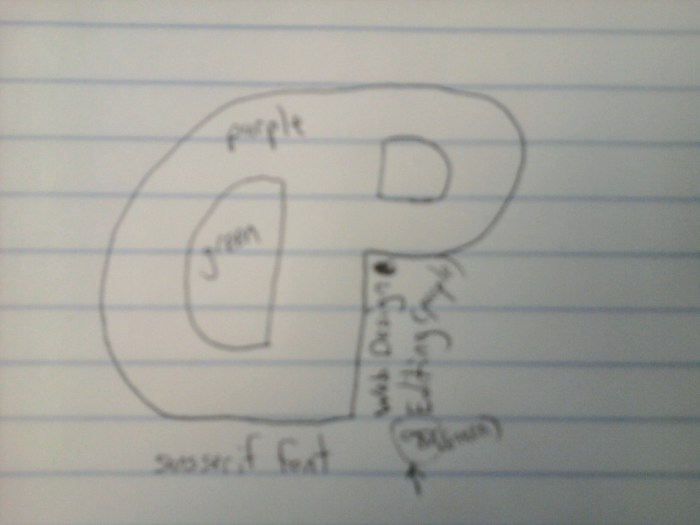
Logo Sketch

Every brand identity begins with an idea.

Week 1: Industry and Type

Week One seems forever away. We spoke of the ubiquity of digital design. We viewed samples of commercial projects. We practiced logotypes and experimented with fonts on Illustrator. The images and concepts float vaguely through my mental processors. I’m eager for today’s class to firmly cement the applications of graphical expressions within my wandering inquisitions.

These images inspired me because they are all a result of creative design. The Hard Rock Cafe doesn’t simply employ a musical instrument as signage; the guitar is upside-down, which catches the eye and generates a force of subconscious tension. Illuminated or not, the sign is hard to miss.

The Snapchat ghost was on a billboard along Hwy 99 for a time. My boyfriend and I would drive past it each morning and wonder what the heck it was supposed to be. It looked like the outline of a Shrek head mask. It wasn’t until I saw the image on the backside of a Starbucks cup that I garnered enough insight to ask my teenage daughter about the image. Personally, I think a pair a small black eyes would assist the portrayal of a ghost. Whoever made a ghost costume out of a sheet without first cutting out eyeball holes?

Vogue is included here because it’s an obvious magazine cover. What struck me about this particular image is the thought process behind it. Someone was in charge of choosing font size and color as well as placement of the words in addition to which words were chosen to highlight the magazine’s content. I was impressed by all of the decision making that results in each individual cover, all of which compete for the attention of the distracted, over-stimulated hurried consumer passing the magazine counter.

What is the deal with the Starbucks logo anyway? It’s weird, simplistic, and makes no logical sense whatsoever. And yet, it’s probably the most recognizable logo in history. The headquarters building only displays a very small part of the logo without anyone questioning what company it belongs to. There are a myriad of variations ranging from sarcastic manipulations to beautiful artistic expansions, and every single one of them is discernibly connected to the original.
VW Ad

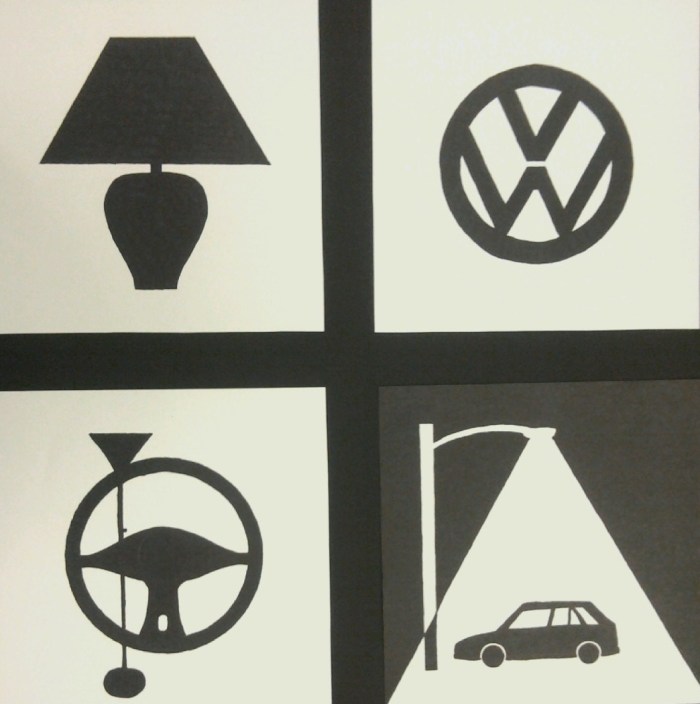
This photo is for a mock advertisement I drew. It uses a known design within the framework of a new context. No one needs to guess which type of car is presented here. The juxtaposition of black and white images is clean and clear. The alteration of positive and negative space adds interested. The bold pictures capture the viewer’s attention. It tells a story without saying a word. Graphic design is about generating emotions and connecting a message, or a brand, within the neurology of the viewer.

Questions

  1. I’m in Winter Quarter 2016, and it’s my second quarter at the Art Institute.
  2. I have an AA in Engineering Technologies, an AutoCAD Certification, and a BA in Interdisciplinary Arts and Sciences. Therefore, I’ve already had several art and drawing classes: Manual Drafting, Drawing from Life, Architectural Drafting, Watercolor Painting, and Design Fundamentals, just to name a few.
  3. My software experience is nil. I used Photoshop a little in Digital Color Theory. I loved AutoCAD until they changed the UI in 2011. I received an introduction to Illustrator earlier today.
  4. My favorite movie is Inception.